-
Construction Phases in Private Projects
-
Commercial Construction Info
- Commercial and Industrial Properties: Construction at the Highest Level
- Planning and Preparation: Turning Your Idea into Reality
- Dismantling and Demolition – Preparation and Execution of Structural Deconstruction
- Shell Construction Works: Essential Structural and Installation Measures
- Electrical Installation and Building Services in Commercial and Industrial Construction
-
Bathroom Renovation and Refurbishment
-
Roof Renovation – Beyond Replacing Tiles
-
Refurbishment and Modernization of Industrial Facilities
-
Underfloor Heating Support Structures
-
Office and Medical Property Renovation
Initial Consultation with Site Survey: The First Step Toward a Successful Construction Project
Overview of the Article
- The phases of a construction project
- Initial consultation with site survey
- The design and planning phase
- Pre-construction preparation
- Construction phase (renovation works)
- Completion and handover
A construction project succeeds or fails based on the quality of its preparation. Whether you are planning a renovation, modernization, refurbishment, or structural alteration, the earliest decisions have the greatest impact on cost, schedule, quality, and ultimately on the outcome. This is precisely where the initial consultation combined with a site survey (“initial consultation with site survey”) comes in. It establishes a shared understanding of the project’s goals, clarifies constraints, and creates the technical foundation for reliable planning.
It is important to set expectations correctly: in this meeting, the final design is typically not fully defined. Instead, the goal is to define the route—scope, priorities, risks, and the next steps—so that subsequent planning and execution can proceed in a structured and transparent manner.
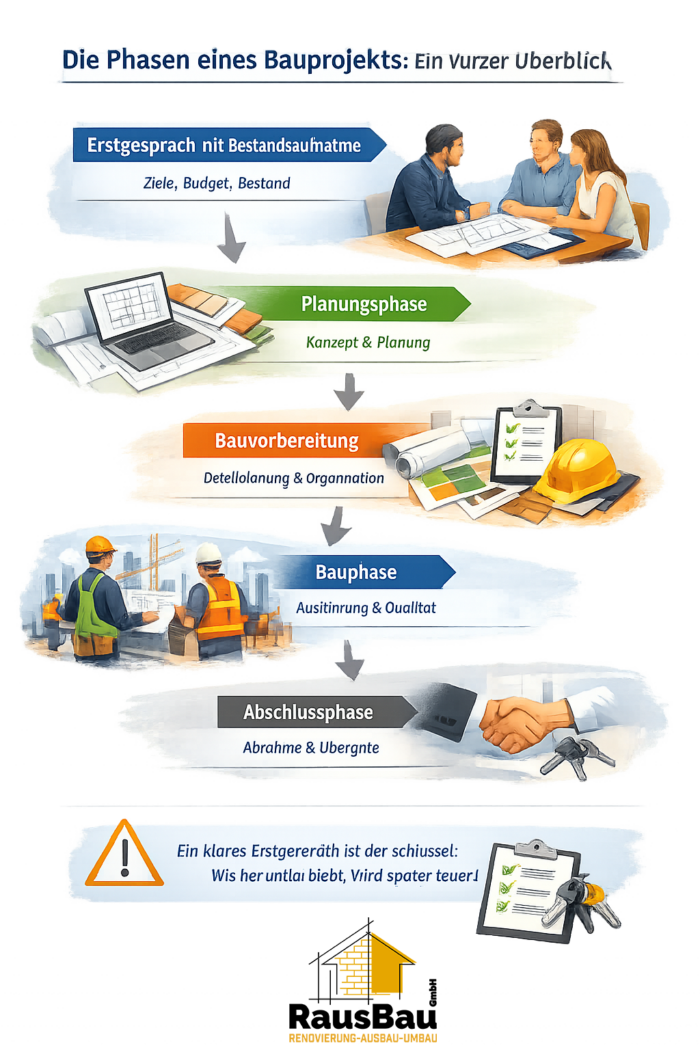
The Phases of a Construction Project: A Brief Overview
Most construction and refurbishment projects follow a consistent logic, even if the details vary depending on the building type and scope:
- Initial consultation with site survey
Project goals, budget framework, on-site assessment, first solution directions - Design and planning phase
Concept development, preliminary design, material and finish strategy, cost and schedule framework - Pre-construction preparation
Detailed planning, procurement and trade coordination, approvals (if required), site logistics and sequencing - Construction phase (renovation/alteration works)
Execution, coordination, quality control, change management - Completion and handover
Inspection, snagging/defects process, documentation, handover, aftercare
The initial consultation is the critical starting point. Anything that remains unclear here tends to resurface later—usually with added cost and delay.
What “Initial Consultation with Site Survey” Means—and Why It Matters
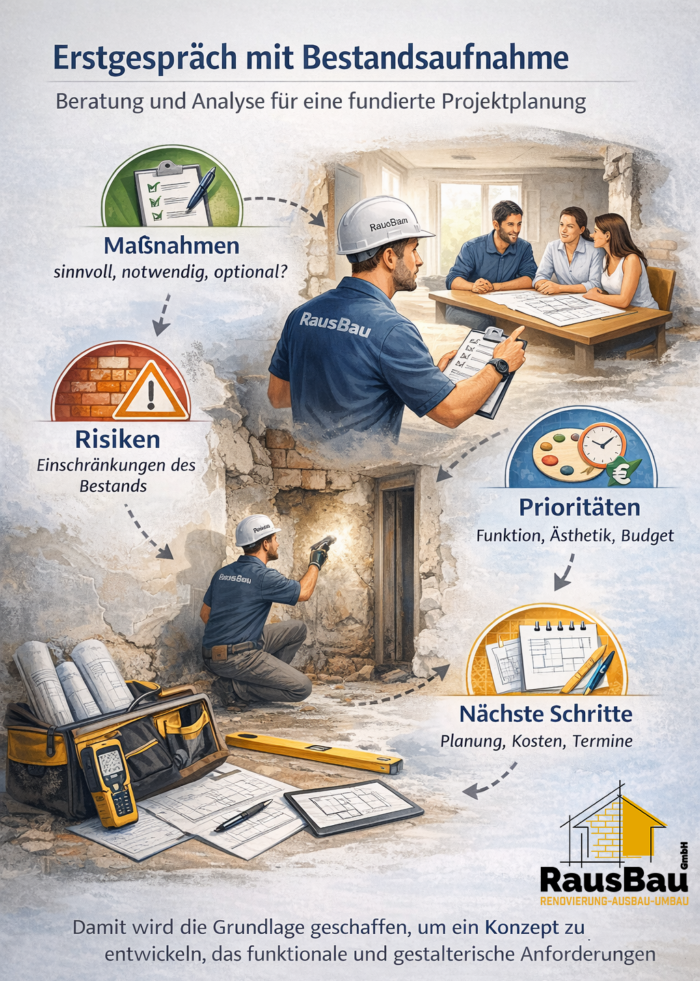
The initial consultation with site survey combines two elements: a structured briefing of the client’s requirements and an on-site technical assessment of the existing building. The objective is to build a robust understanding of:
- What needs to be done (and what is optional)
- What the building actually allows, including constraints and risks
- Which priorities govern the project (function, aesthetics, budget, timeline)
- Which next steps are required (planning, cost estimate, specialist input)
This ensures that the resulting concept is not only visually appealing, but also technically feasible, compliant, and economically sensible.
Key Objectives of the Initial Consultation
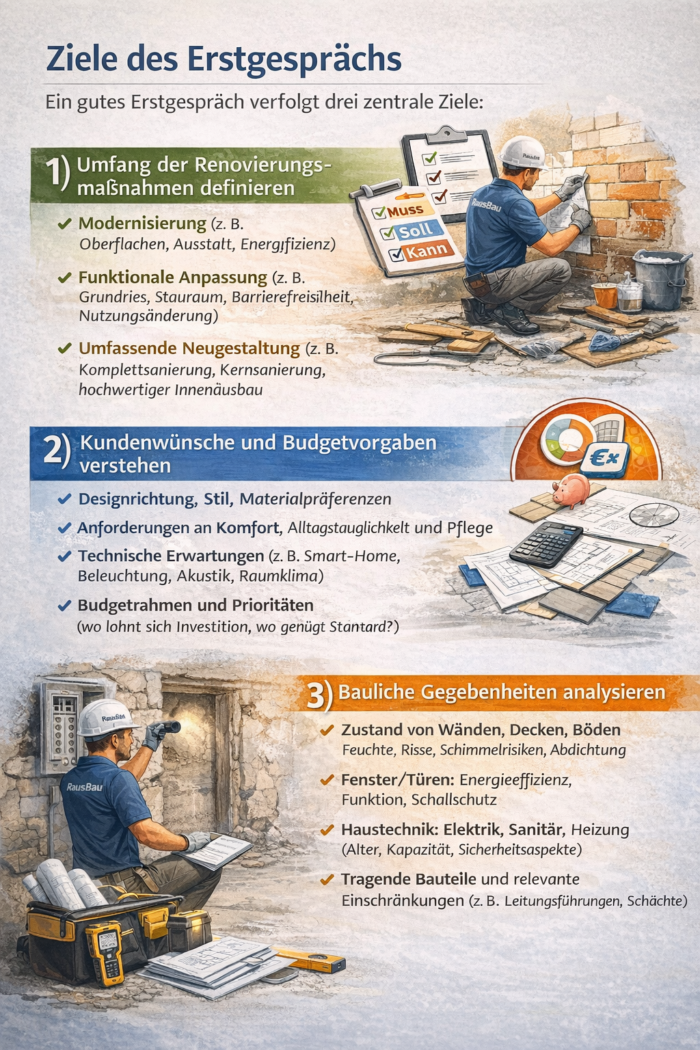
A well-run initial consultation typically focuses on three core objectives:
1) Defining the scope of works
The project team identifies the likely scope and categorizes measures clearly:
- Modernization (e.g., finishes, fixtures, energy-related improvements)
- Functional adaptation (e.g., layout adjustments, storage, accessibility, use changes)
- Comprehensive refurbishment (e.g., major renovation, full interior fit-out)
2) Understanding the client’s requirements and budget framework
Good planning requires a clear brief. Typical discussion points include:
- Design preferences and style direction
- Material and finish expectations
- Functional requirements (day-to-day use, durability, maintenance)
- Technical expectations (lighting concept, acoustic comfort, indoor climate, smart-home needs)
- Budget parameters and priorities (where to invest, where standard solutions suffice)
3) Assessing the existing building (technical condition and constraints)
The building’s current condition heavily influences feasibility, cost, and scheduling. Key aspects include:
- Condition of walls, ceilings, floors and substrates
- Moisture, cracks, mould risk, waterproofing issues
- Windows and doors: performance, airtightness, sound insulation, energy efficiency
- Building services: electrical, plumbing, heating (age, capacity, safety)
- Structural constraints (load-bearing elements, shafts, service routes)

Typical Process: Step by Step
Appointment scheduling and initial information gathering
The process begins with coordination and basic pre-briefing:
- Agreeing an on-site meeting: A site visit is essential to assess the property properly.
- Collecting key information beforehand: For example:
- Type of property (old building/new build, residential/commercial)
- Main objective (upgrade, reconfiguration, full refurbishment, value enhancement)
- Target timeframe (move-in date, vacancy window, business downtime constraints)
- Special constraints (shared ownership/HOA requirements, heritage protection, access restrictions)
This preparation improves the quality and efficiency of the on-site meeting.
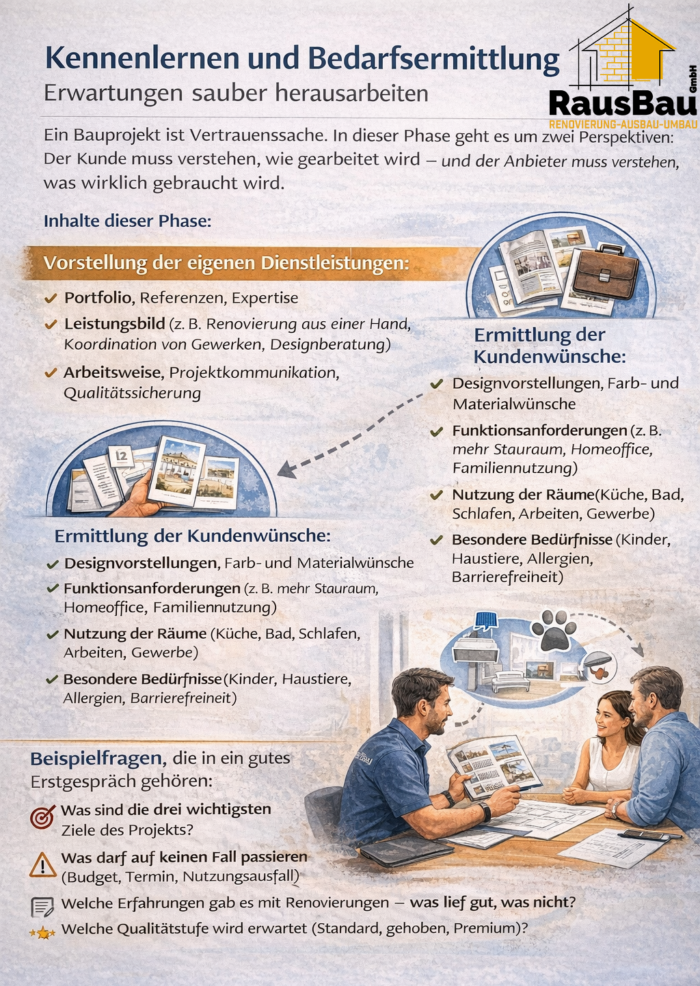
Introduction and requirement briefing (the client brief)
A solid understanding of the client’s expectations is central:
- Presentation of services and approach: Capabilities, references, typical project process, and coordination method
- Clarifying the brief: Detailed discussion of:
- Style preferences, colour and material direction
- Functional needs per room (kitchen, bathroom, office, living spaces)
- Specific user requirements (children, pets, allergies, accessibility)
Professional note: The more specific the brief, the more reliable the cost and schedule framework becomes.
On-site survey: the technical basis for planning
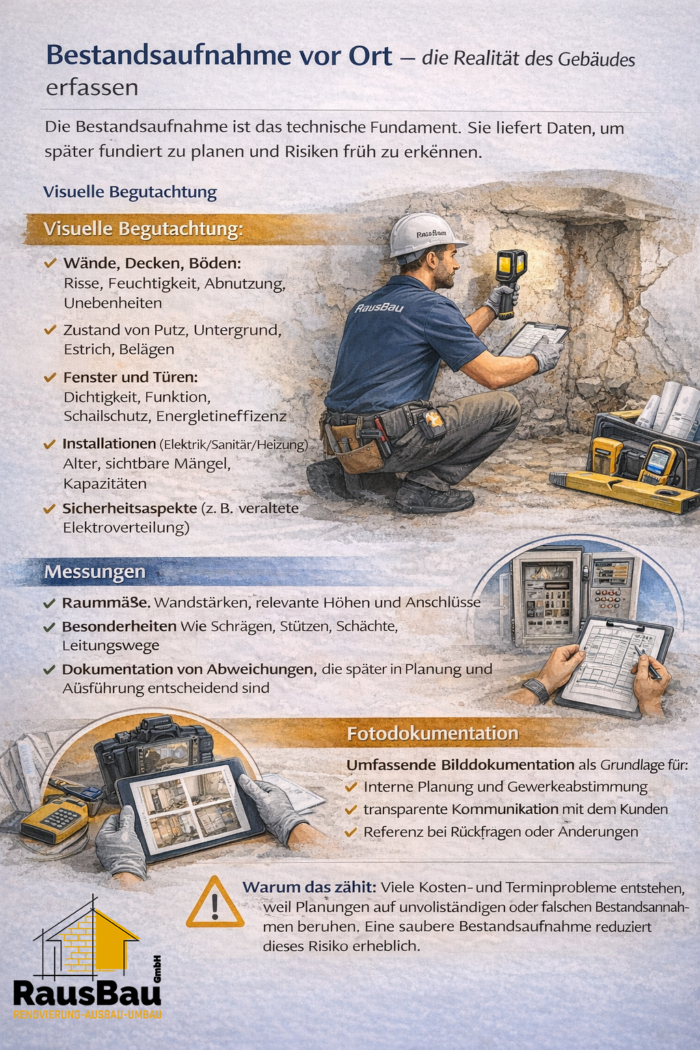
The site survey provides the factual foundation for subsequent design and costing.
Visual inspection
- Walls, ceilings, floors:
- cracks, damp, wear, unevenness, substrate condition
- Windows and doors:
- operation, airtightness, energy performance indications, sound insulation
- Building services (MEP):
- visible condition of electrical distribution, plumbing runs, heating system elements
Measurements
- Room dimensions, heights, wall thicknesses where relevant
- Recording constraints and peculiarities (slopes, structural supports, shafts)
- Verifying plan accuracy where existing drawings are outdated or missing
Photo documentation
- Comprehensive photo record for:
- internal planning and trade coordination
- transparent client communication
- reference for clarifications and variations later
Why it matters: Many variations and cost increases originate from incorrect assumptions about the existing structure or services. A thorough survey significantly reduces this risk.
- Walls, ceilings, floors:
Initial advisory discussion: outlining solution directions
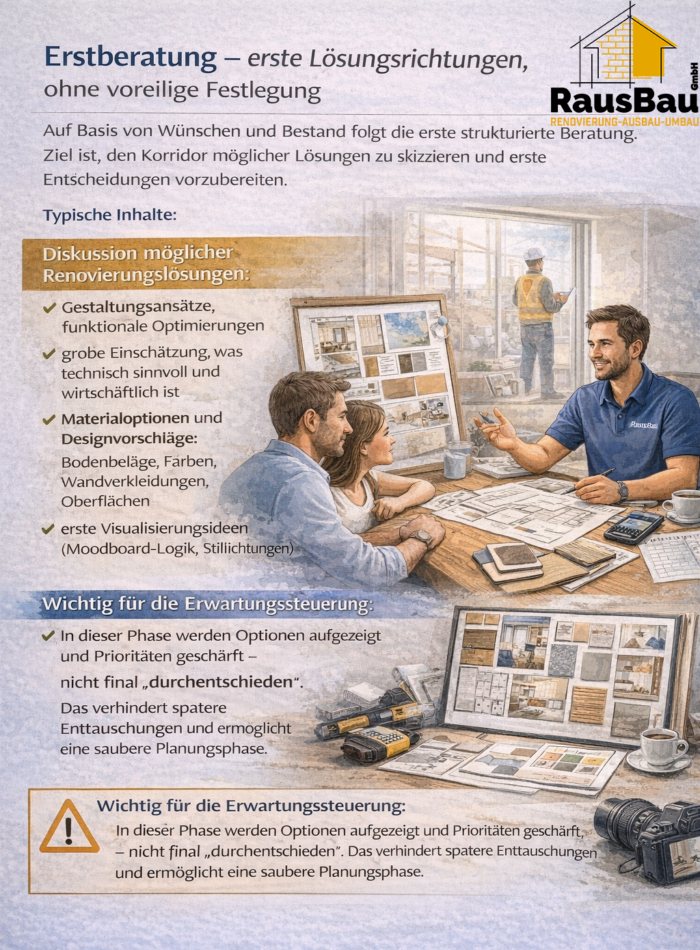
Based on the site findings and the brief, an initial advisory discussion follows:
- Discussing possible renovation/alteration strategies:
Options for layout, finishes, technical upgrades, and practical sequencing - Introducing material and design directions:
Examples of floors, colours, wall finishes, joinery options, and first design cues
At this stage, recommendations remain directional. Final decisions are typically made during the planning phase, supported by drawings, specifications, and reliable cost data.
- Discussing possible renovation/alteration strategies:
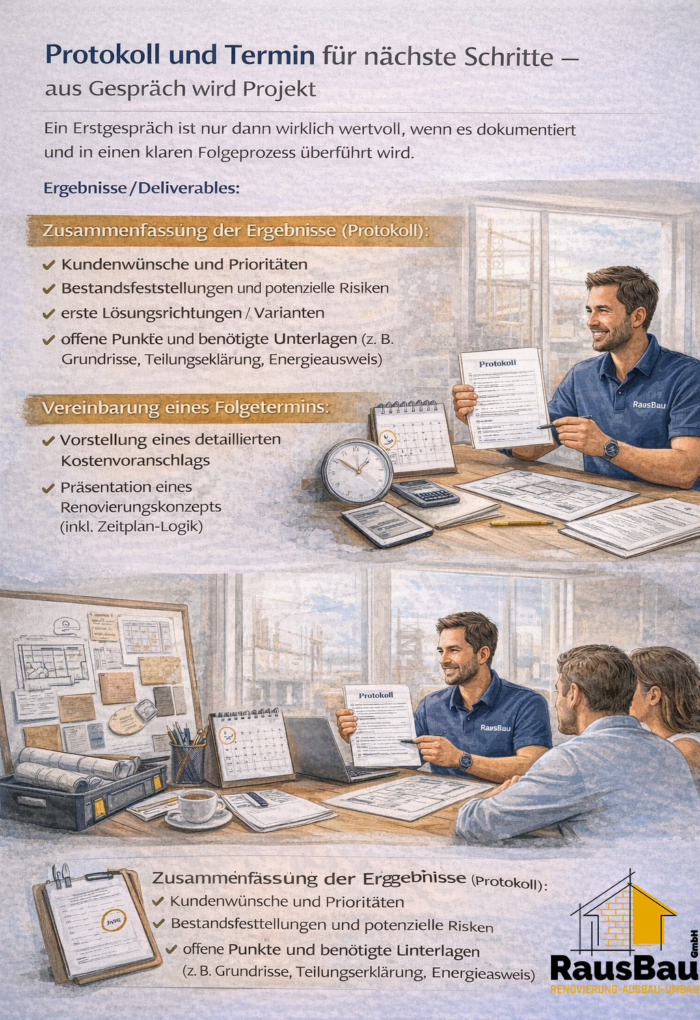
Meeting summary and next steps
The consultation should always conclude with clear documentation and an agreed path forward:
- Written summary (minutes):
Key requirements, priorities, survey findings, constraints, risks, and open points - Follow-up appointment:
Presentation of a more detailed concept and an initial cost estimate or quotation, depending on scope
- Written summary (minutes):
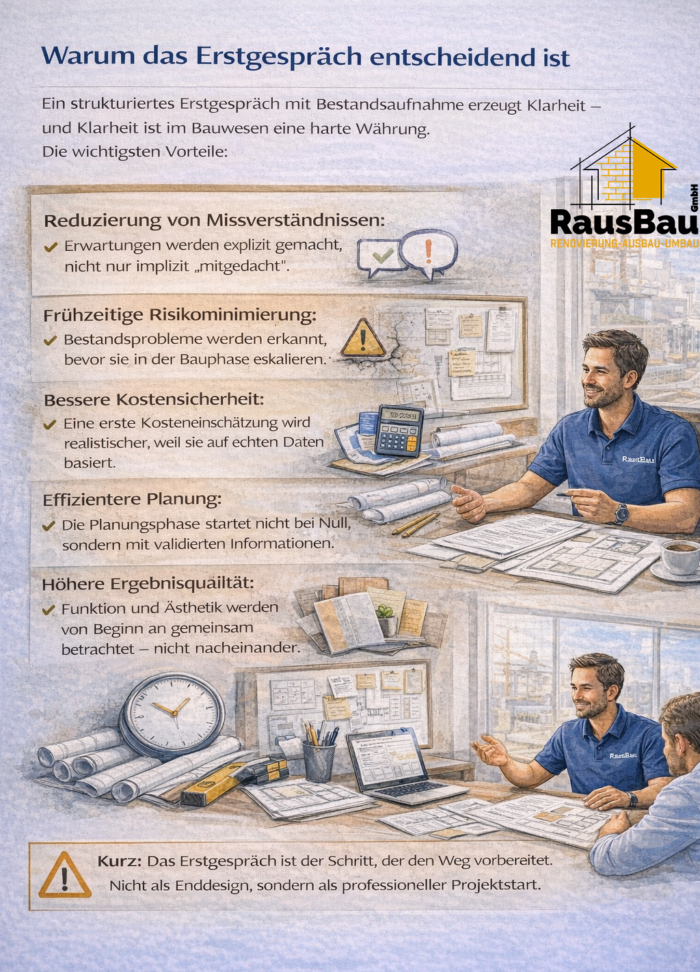
Why the Initial Consultation Is So Important
A structured initial consultation with site survey provides clarity and reduces uncertainty. Key benefits include:
- Clear expectations and fewer misunderstandings
- Early identification of risks and constraints
- More reliable cost and schedule assumptions
- A more efficient design process
- Higher quality outcomes, balancing aesthetics, function, and technical feasibility
Put simply: this meeting sets the direction. It does not define every detail of the final result, but it establishes the framework that makes successful delivery possible.
Common Pitfalls—and How the Initial Consultation Prevents Them
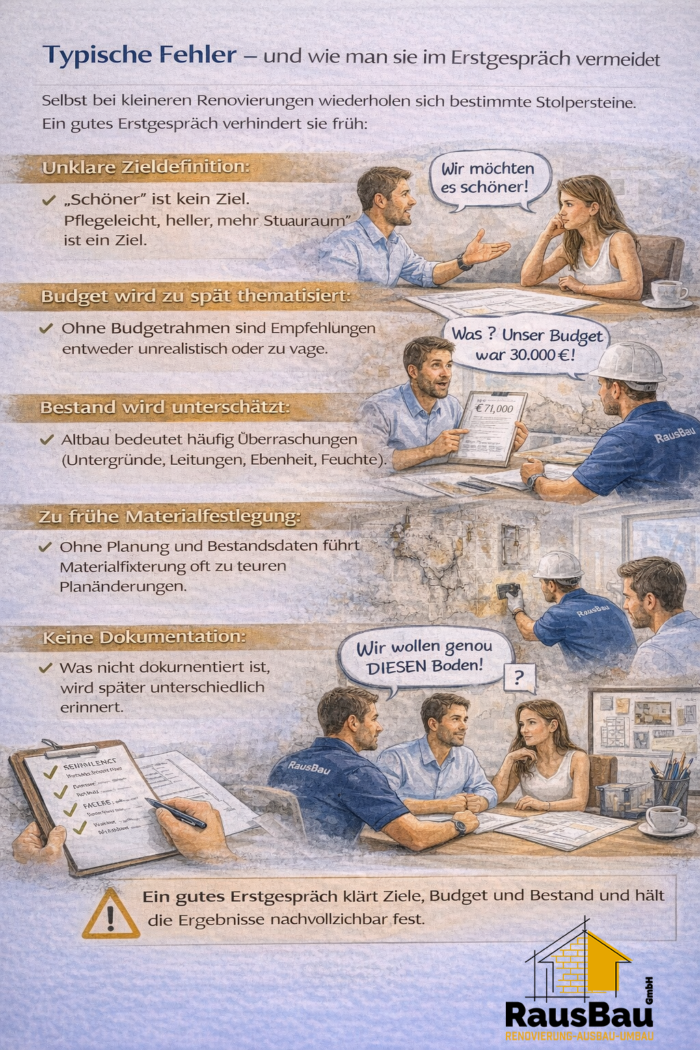
Certain issues recur frequently in renovation projects. A good initial consultation addresses them early:
- Vague objectives (“make it nicer”) instead of measurable goals
- Budget discussions postponed until design is already developed
- Underestimating existing-building realities (especially in older properties)
- Premature fixation on specific materials without understanding substrate and constraints
- Missing documentation, leading to conflicting recollections later
Practical Checklist: What to Bring to the Initial Consultation
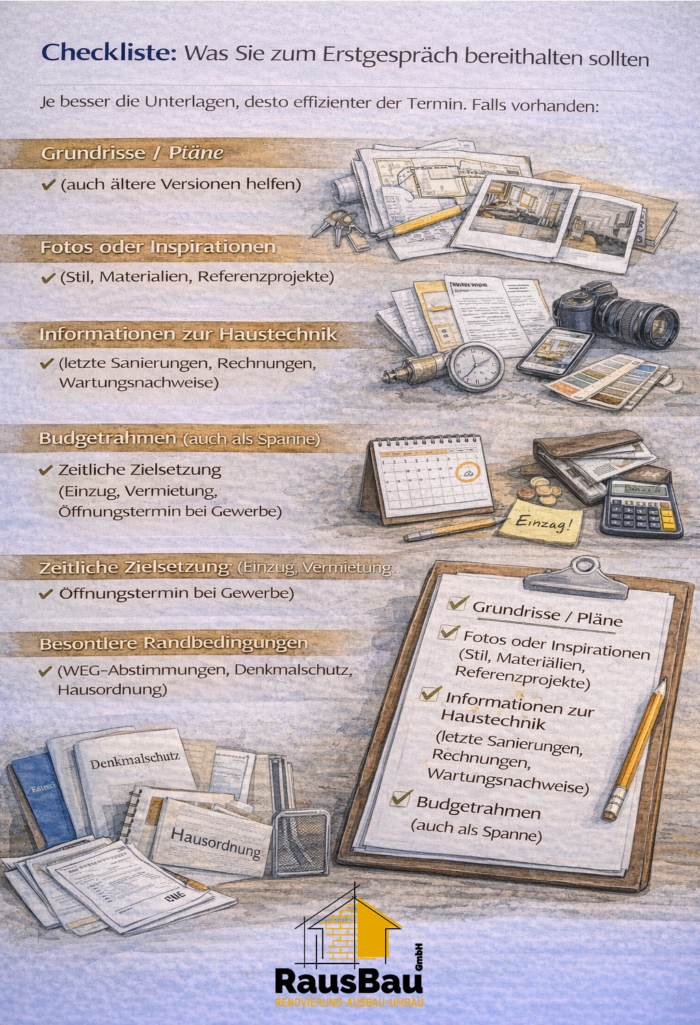
If available, the following items improve efficiency and accuracy:
- Existing floor plans or drawings (even older versions)
- Inspiration images (style, finishes, reference projects)
- Information on previous works and building services upgrades
- Budget range (even as a corridor)
- Target timeframe and constraints
- Special requirements (HOA approvals, heritage protection, house rules, access limitations)
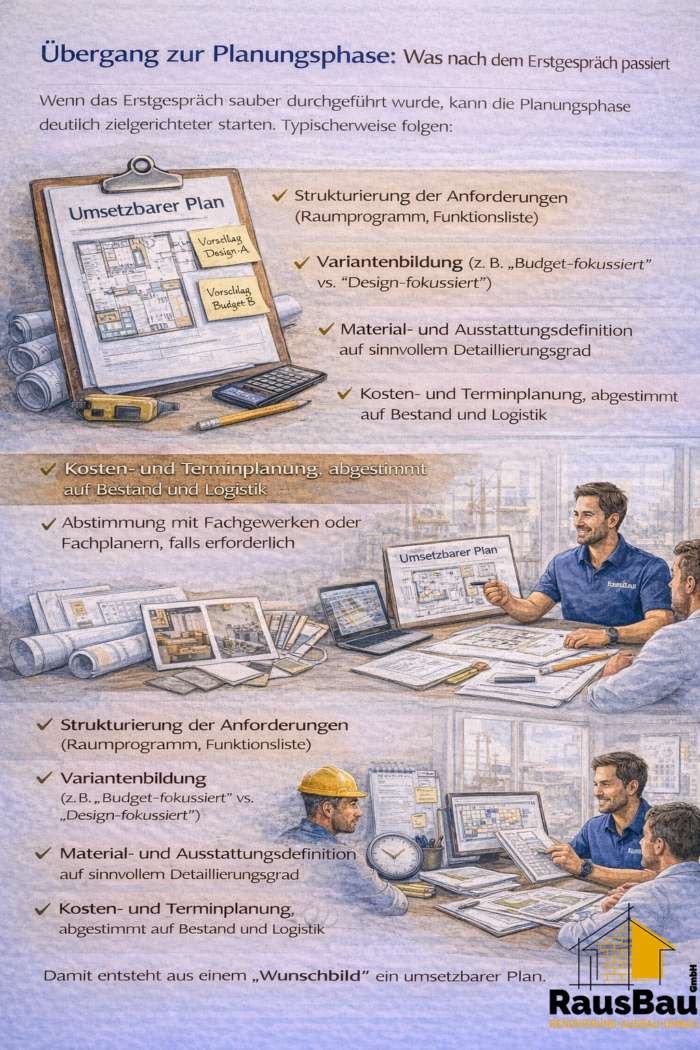
Transition to the Planning Phase: What Happens After the Initial Consultation
If the initial consultation is carried out thoroughly, the planning phase can start far more purposefully. The following steps typically take place:
- Structuring the requirements (room program, functional brief)
- Developing variants (e.g., “budget-focused” vs. “design-focused”)
- Defining materials and specifications to an appropriate level of detail
- Cost and schedule planning, aligned with the existing conditions and site logistics
- Coordination with specialist trades or design consultants, if required
This is how a “wish list” is converted into a practical, buildable plan.
Conclusion: Without an Initial Consultation, There Is No Reliable Construction Project
The initial consultation with site survey is the most important first step in any successful construction or refurbishment project. By aligning project goals, budget, expectations, and the reality of the existing building, it creates the foundation for reliable planning and controlled execution. The meeting itself does not finalize what the project will look like in every detail—but it defines the path forward, reduces risk, and sets up the conditions for a result that is technically sound and aligned with the client’s needs.
Request an Initial Consultation with Site Survey
Are you planning a renovation, modernization, or redesign and want clarity from the outset—on feasibility, costs, and the right project approach? Book an initial consultation with site survey. We will assess your property on site and establish a solid foundation for a successful construction project.
RausBau GmbH
📍Rathausplatz 2,
85748 Garching b. München
🌐 www.rausbau.com
📧 info@rausbau.com
📞 +49 89 99858903
- budget planning
- building condition assessment
- building survey
- change management
- construction project
- contractor Munich
- cost estimate
- handover
- initial consultation
- measurements
- modernization
- on-site inspection
- photo documentation
- pre-construction
- project planning
- quality control
- RausBau
- refurbishment
- renovation planning
- scope of works
- site survey